NVIDIA and Cisco Plan USFP Optics: Understanding the 6.4T-to-12.8T Roadmap
NVIDIA and Cisco announced USFP design plans on October 12. Understand 400G lanes, initial 6.4T capacity, the 12.8T roadmap and availability limits.
NVIDIA and Cisco announced design plans for Ultra-Dense Small Form Factor Pluggable, or USFP, at the OCP event in Santa Clara on October 12, 2026. The proposed optics format targets denser AI Ethernet networks, with electrical signaling at 400 Gb/s per lane and a path toward 12.8 Tb/s capacity.
The key distinction is between that longer-term capacity path and the first planned configuration. Neither the announcement nor the independent coverage reviewed for this article provides a sampling schedule or commercial availability date.
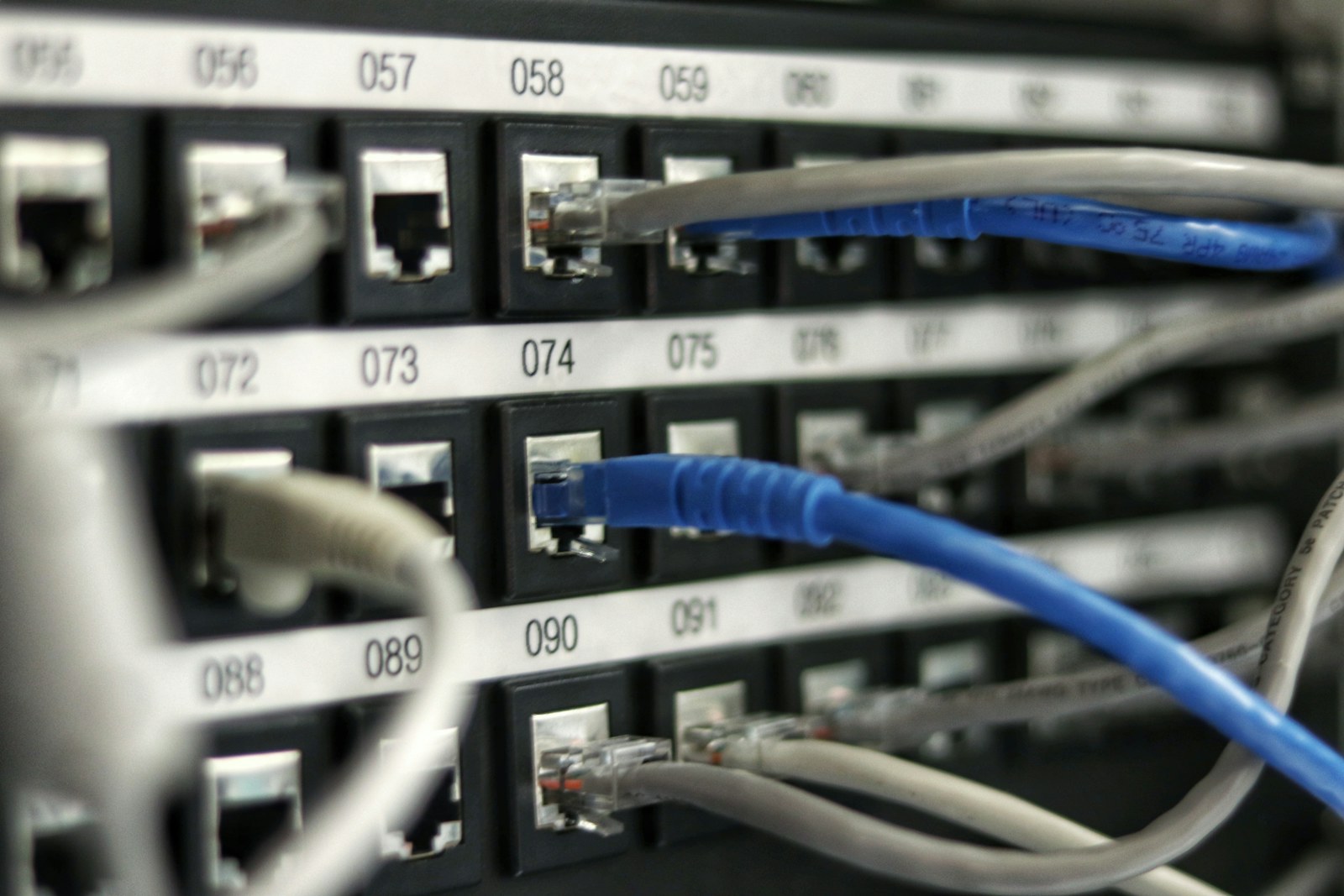
Illustrative Ethernet patch panel; this image does not show a USFP optical transceiver. Photo: Jordan Harrison / Unsplash, Unsplash License.
Why the headline capacity needs explanation
Cisco's executive explanation states that 16 lanes at 400 Gb/s yield 6.4 Tb/s, with a future 32-lane design providing a path to 12.8 Tb/s. StorageReview's October 12 coverage makes the same initial-versus-future distinction.
- First planned arrangement: 16 × 400 Gb/s = 6,400 Gb/s, or 6.4 Tb/s.
- Expansion path: 32 × 400 Gb/s = 12,800 Gb/s, or 12.8 Tb/s.
This is lane-rate arithmetic, not a measurement of application throughput. Full-duplex links carry traffic in both directions simultaneously; adding both directions together would not make a one-direction 6.4 Tb/s connection into a 12.8 Tb/s one. The lane count and the direction being measured need to remain explicit.
What the companies actually announced
The joint release on Cisco's newsroom, also published by NVIDIA, describes first planned transceivers with 16 full-duplex lanes in an OSFP-sized footprint. NVIDIA and Cisco claim four times the front-panel bandwidth density and approximately 1.3 times the power efficiency of 200 Gb/s-per-lane pluggables.
They are working with TE Connectivity and Amphenol on the hardware ecosystem and intend to develop an open specification through a community-led multi-source project. An announced intention to create a specification is different from a completed standard with demonstrated interoperability.
The release also describes a new connector with contacts that engage after insertion and support for transceiver power dissipation up to 100 watts without a separate embedded cooling circuit. These are manufacturer design claims. A module's stated thermal capability is not a claim that the surrounding switch needs no cooling.
How density can affect an AI network
Makezaa analysis: a switch has finite space for connectors. Increasing capacity within that space can change how many endpoints a network can accommodate before another switching layer becomes necessary. The useful comparison therefore includes port layout and topology, rather than treating a faster module as an isolated upgrade.
It does not follow that every model will train or respond four times faster. A workload may be limited by compute, memory access, storage or synchronization elsewhere. Network improvements matter most when communication is the bottleneck. Operators should identify that bottleneck before translating an optics specification into an application-performance expectation.
Likewise, physical size is only one compatibility condition. Electrical signaling, connector design, firmware support, optical reach and thermal limits all need to align. An OSFP-sized footprint should not be interpreted as proof that USFP modules can be inserted into every existing OSFP port.
Serviceability deserves its own evaluation
Higher density makes maintenance procedures more consequential. A practical evaluation should include replacement access, cable identification, fault isolation and the behavior of the network while a component is serviced. A design that moves more traffic through a smaller area still needs a workable recovery process.
Power comparisons also need a defined boundary. Measure modules and the surrounding switching system under a comparable traffic load, then consider any topology changes. A per-module efficiency improvement cannot simply be applied to the entire data center's electricity bill.
For teams considering future procurement, the immediate action is to track specification publication, supported host systems, interoperability results and vendor availability. Capacity figures are useful planning inputs; a deployment decision also needs products that can be tested and maintained.
USFP is a proposal to extend pluggable optics into a higher-bandwidth generation. Its initial 6.4 Tb/s configuration and 12.8 Tb/s expansion path are clearer when discussed separately, with the performance claims attributed and commercial timing left open.