Our 2026 SEO Strategy: Service Pages, Search Intent and Evidence That Matters
A transparent look at Makezaa's SEO strategy: intent-led service pages, real project evidence, crawlable foundations, AI discovery and the measures we will use.
Search visibility is a business problem before it is a ranking problem. Someone looking for a WordPress website, a Shopify storefront, or a custom web application is asking for three different things. A single broad “web development” page cannot explain all three decisions well. In October 2026, we began rebuilding Makezaa’s search approach around those distinct needs, the evidence a buyer needs before contacting us, and a site that search engines and AI-assisted tools can read reliably.
This is our working strategy, not a victory announcement. Our review of Google Search Console showed that visible search activity for the agency site was concentrated in brand and existing pages. It did not establish strong rankings for our new service terms. That is why our next steps start with useful pages and measurement rather than a promise of a top position.
Start with the searcher’s job
We map a candidate phrase to the page that can answer it completely. The homepage introduces Makezaa’s web and technology services. It is the right home for broad agency searches such as “web design and development agency in Dhaka.” A platform buyer needs something more specific, so we created separate pages for WordPress website development, Shopify store development, and custom web development.
Those terms are research candidates, not measured winners. “WordPress website development in Bangladesh,” “Shopify developer in Dhaka,” and “custom web application development in Dhaka” describe distinct buying intents. Related phrases belong on the same page when they refer to the same decision. We do not plan a thin page for every word order or every city. We will refine the language using actual page-and-query data as the new URLs earn impressions.
Give each service page a clear decision path
A useful service page should say what is delivered, who it fits, where a standard platform may be enough, and what a potential client needs to share to receive a realistic scope. Our WordPress page discusses editable business sites, setup, launch and handover. The Shopify page focuses on storefronts, themes, products and integrations. The custom development page explains when portals, dashboards, APIs or complex workflows need a purpose-built solution.
We keep the pages connected through relevant links. A visitor comparing platforms can move between the WordPress and Shopify offers. Someone considering custom work can see whether a standard platform would solve the problem more simply. Each page gives a direct route to contact us with requirements. This is a better reader journey than repeating a generic pitch three times.
Use portfolio evidence carefully
Our published projects are the proof layer. A project detail can help a buyer understand the problem, the work performed and the technology involved. The next editorial step is to strengthen relevant case studies with client-approved challenge, scope and implementation details, then link them from the matching service page. We will add outcomes only when we have a reliable source and permission to publish them. We will not turn a concept, mock-up or unverified number into a customer result.
That makes the portfolio useful to both people and search systems. It gives context behind a claim and lets a visitor inspect the work instead of relying on unsupported testimonials. It also creates natural routes from an information page to a real example and from that example to the relevant service.
Keep the technical foundation readable
Content cannot help much if its URL is inaccessible or unclear. Makezaa’s public pages have canonical URLs, descriptive titles, a published-content sitemap and server-rendered page content. The site’s robots.txt permits public pages and their rendering assets to be crawled while excluding private API paths. Public posts and projects appear in the sitemap only when published. Administrative and account pages carry noindex directives; authentication still protects private information.
We also improved the initial page experience by removing a loader that held back homepage content, deferring the large hero video until it is needed, and reducing a heavy favicon. These are implementation changes, not a claim that field Core Web Vitals have improved. We will evaluate real user and lab data before making that claim.
Our structured data follows what is visibly true: organization and website identity, service descriptions, blog articles, breadcrumbs and a video on its playable watch page. We avoid fabricated reviews, ratings and outcomes. Google’s structured data guidelines require markup to represent page content, and valid markup does not guarantee a rich result. We treat it as a way to describe real content, not a shortcut to rankings.
Make information easier for AI-assisted discovery
We added a concise llms.txt guide and a public Agent.md reading guide that point to actual service, project and contact pages. They help a reader or an AI tool find the canonical source, but they do not grant access to private data and do not guarantee an AI citation. The stronger foundation is the same one we use for ordinary search: crawlable pages, clear wording, relevant links and claims that readers can check.
Google says its AI search features rely on the established SEO fundamentals and have no additional special optimization requirement. We therefore focus on complete answers and real sources rather than writing for an imagined “AI ranking” formula.
Publish content that resolves a buying question
Our editorial queue is built around questions that arise before a project brief, not around a target word count. Three examples are a WordPress-versus-Shopify decision guide, a breakdown of the components that affect a Shopify project budget, and a custom-app scoping checklist covering users, roles, data, integrations and handover. Each guide should show trade-offs, link to the relevant service, and explain when Makezaa may or may not be the right fit.
We will also review existing news-led blog posts for original value, accurate dates and primary sources. A post that merely repeats a product announcement has less reason to exist than one that helps a business apply the change. Google’s people-first content guidance asks whether a reader leaves with a satisfying answer and whether the page adds value beyond its sources. That is our editorial test.
Measure the right results, then revise
Our Search Console property covers the whole makezaa.com domain, including subdomains. For the agency website, we filter to exact https://www.makezaa.com/ page URLs before interpreting performance. We then look at each service page’s index status, non-brand query impressions and clicks, the searches leading to a relevant project or article, and whether visitors proceed to a useful enquiry. Search Console hides some low-volume queries, so we will not pretend its visible rows are a complete keyword list.
At roughly 28 days after a meaningful page change, we will check whether the page is indexed and which queries it begins to attract. Around 90 days, we can assess direction with a longer window and decide whether the page needs clearer answers, stronger examples, better internal links or a different intent match. Position alone is not enough: a qualified project conversation matters more than an unrelated impression. Search results change by location, device and time, and no responsible strategy can promise positions one through three for every query.
A practical checklist for another service business
- Separate broad company discovery from specific service decisions.
- Write one substantial page per real offer and distinct intent.
- Show verifiable work next to the claims it supports.
- Keep public pages, assets and useful links crawlable; protect private data separately.
- Use schema only for content readers can actually see.
- Answer pre-purchase questions with original, sourced guidance.
- Filter analytics to the right website and review leads as well as visibility.
If your business is planning a WordPress site, Shopify store or custom application, explore the relevant Makezaa service page and send us the problem you are trying to solve. The right starting point is a clear scope, not a guaranteed search position.
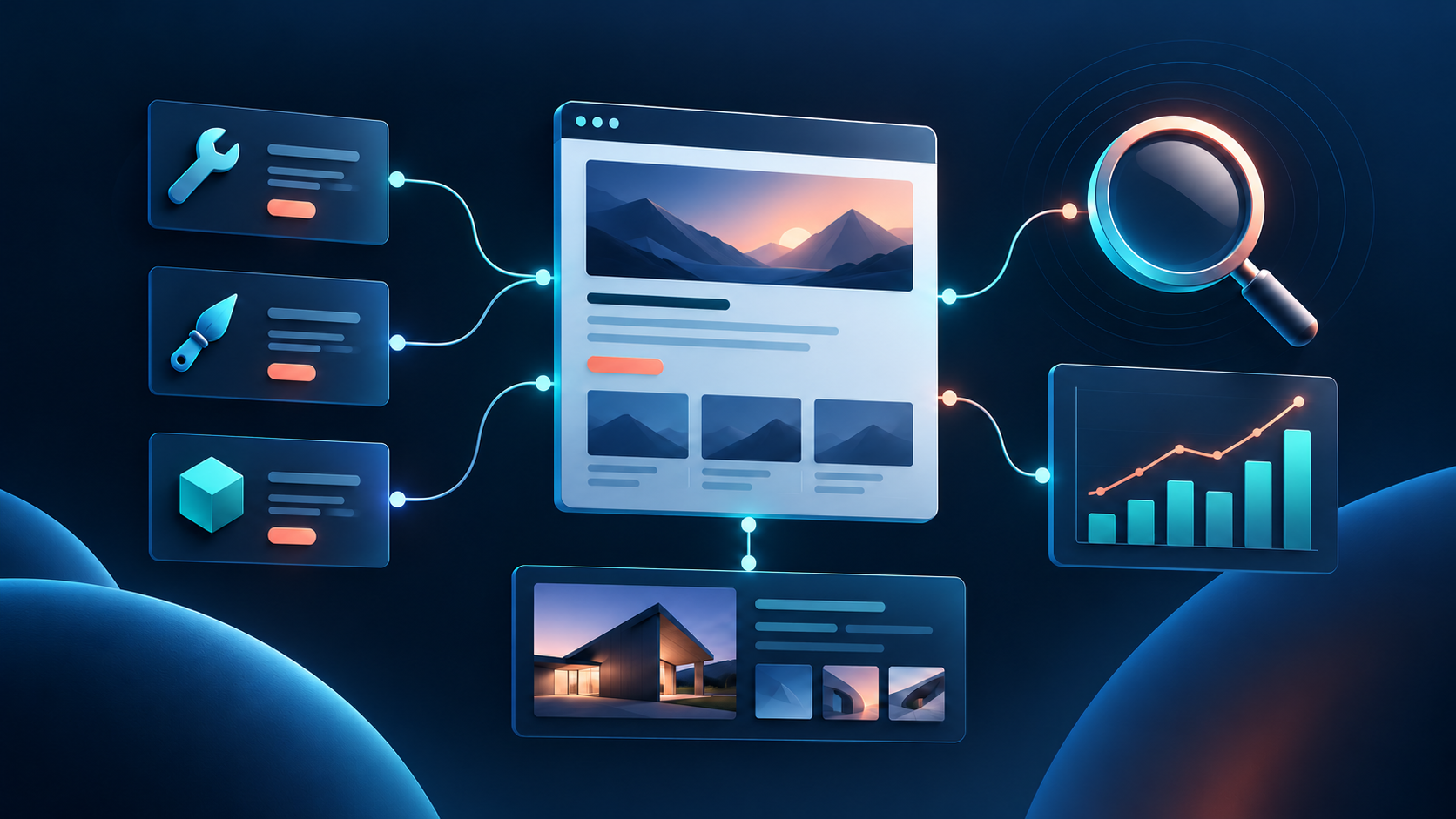
Cover image: original AI-generated editorial illustration of the strategy’s connected parts; it is not a screenshot or a performance chart.