Microsoft Maia 300 Targets 2027 Deployment as AI Inference Scales
Microsoft announced Maia 300 for 2027 deployment. Explore its HBM4 and rack design, current Maia 200 use and the limits of efficiency claims.
Microsoft announced Azure Maia 300 on October 12, 2026, with production deployments planned for 2027. Its broader Maia program is intended to reach multi-gigawatt scale from that year and become the primary inference system for Microsoft's products and services. This is a roadmap announcement, not confirmation that Maia 300 is serving customers today.
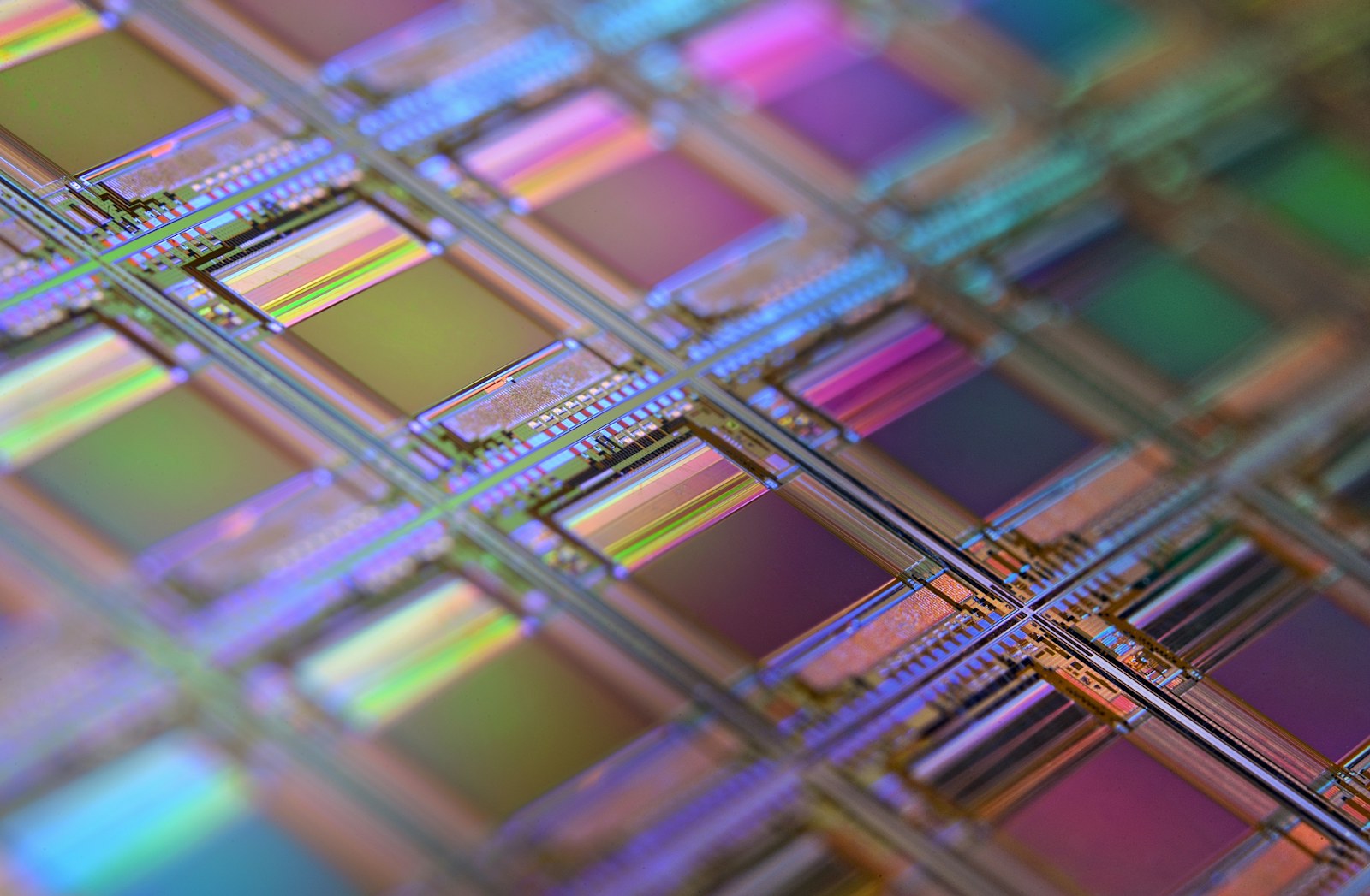
Illustrative semiconductor wafer; this is not a photograph of Microsoft's Maia 300. Photo: Laura Ockel / Unsplash, Unsplash License.
Separate today's production system from next year's plan
The official announcement says Maia 200 already supports production workloads including Microsoft Copilot and the MAI team. GitHub Copilot and Microsoft Foundry are expected to follow by the end of 2026. Keeping those generations separate prevents a future chip specification from being mistaken for an immediately available service.
Reuters reported the announcement on October 12 at 1:01 p.m. UTC. Its coverage describes potentially more than one million Maia 300 chips next year and notes that Microsoft did not identify the GPU systems behind its efficiency comparison. The deployment scale remains a plan rather than an installed inventory.
A system built around moving data efficiently
Microsoft's architecture explanation, published October 12 by Rani Borkar and Saurabh Dighe, describes separate compute, memory-controller and I/O chiplets. Compute uses TSMC's N2P process. Each accelerator has eight HBM4 stacks, 288 GB of memory and 18 TB/s of peak memory bandwidth.
The proposed rack contains 96 accelerators in a 167-kilowatt power envelope. Microsoft's design uses electrical connections within racks and optical connections between racks, with a scale-up domain extending to 12,288 accelerators. Software can place work and data across that domain, including separating prompt processing from token generation.
Makezaa analysis: the architecture is useful to understand because an inference service does more than perform arithmetic. It also moves model state and intermediate data. Extra compute capacity has limited value if the required data arrives too slowly. Memory capacity, bandwidth and placement therefore belong in the same discussion as processor throughput.
What the efficiency claims do—and do not—measure
Microsoft expects Maia 300 to deliver 40% more tokens per megawatt than leading GPU-based systems. That is a company comparison, not a benchmark reproduced by Makezaa. Its technical post also claims up to seven times Maia 200's rack-scale token throughput in the full configuration.
These figures describe different comparisons. A rack with more accelerators can process more work while also consuming more power. A tokens-per-power comparison attempts to account for that power, but readers still need the model, precision, workload size, concurrency and latency target to assess whether the result applies to their service.
Tokens are not a universal measure of useful work either. A coding agent may generate a longer answer without solving a problem, while a shorter response may be sufficient. For application evaluation, pair throughput with task success and response-time constraints. That avoids treating output volume as a direct substitute for quality.
Implications for developers and infrastructure planning
For most application teams, the relevant interface remains the service they consume. A first-party hardware roadmap alone does not establish public instance availability, a migration deadline or a new API price. Check product-specific documentation before assuming that Maia 300 changes an existing deployment.
Developers can nevertheless prepare better measurements now. Keep representative prompts and task outcomes, distinguish time to first response from total completion time, and record concurrency alongside latency. Those measurements help compare services when underlying hardware changes, even when the hardware itself is not exposed to the customer.
Facility planners face a separate question. Rack power is only one part of a deployable system: cooling, distribution, networking, maintenance and spare capacity must work together. Dense compute specifications should be evaluated against actual facility constraints rather than multiplied into a guaranteed capacity forecast.
Our coverage of the reported Amazon–Decart talks examines another inference-related development, with its own unconfirmed deal status. The common engineering issue is how software behavior and infrastructure economics interact; the two announcements are separate events.
Maia 300 provides a detailed direction for Microsoft's next inference platform. The next evidence to watch is production deployment, workload-specific results and the services through which those improvements become available.